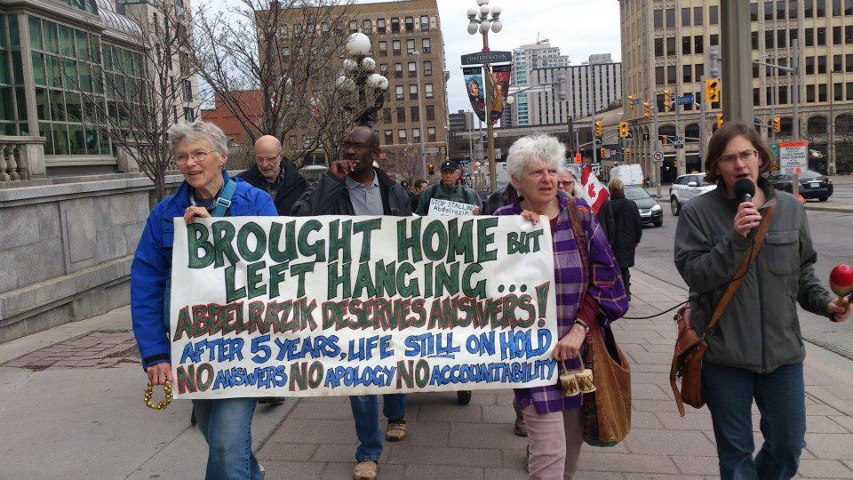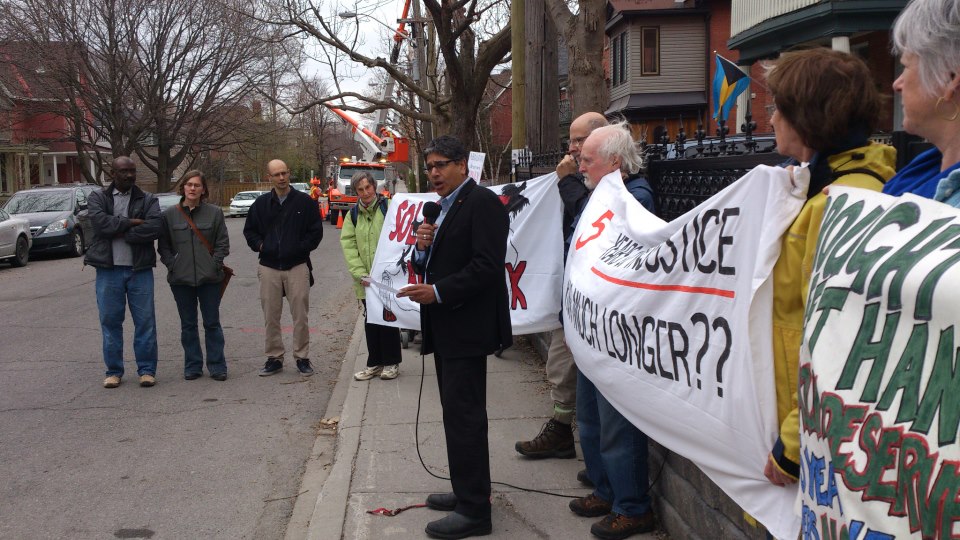


Abousfian Abdelrazik: Project Fly Home

winter morning blues

Listen to:
* winter morning blues
for Abdelrazik

saxophone — Matana Roberts
piano — Stefan Christoff
recorded by Thierry Amar @ Hotel 2 Tango

Statement from Abousfian

Listen to an audio statement from Abousfian Abdelrazik on April 1st, 2009 by clicking the play button below. You can download the MP3 here.

Abdelrazik: Freed at last from the “Prison without walls”

Abdelrazik: Freed at last from the “Prison without walls”

Speakers (left to right): Manon Perron, CSN-CCMM (hidden by camera); Philippe Robert de Massy, Ligue des droits et libertés (hidden by camera); Brian Aboud, Project Fly Home; Émilie Breton, Project Fly Home; Abousfian Abdelrazik; Paul Champ, lawyer; Khaled Elgazzar, lawyer; Sameer Zuberi, Canadian Muslim Forum (hidden by camera).

MONTREAL, 1 December 2011 – Late yesterday afternoon, the United Nation’s 1267 Committee went public with its decision to delist Abousfian Abdelrazik from its blacklist.

"It is difficult to say just how happy I am to have received this decision at last. It's like I'm dreaming: I have finally gotten back the freedom that was stolen from me," said Mr. Abdelrazik, visibly moved by the recent events, to journalists and supporters at a press conference on Thursday morning. "I want to thank everyone, across Canada and around the world, who have supported me. It was a very long struggle, years, and together we have won, from Halifax to Vancouver. Thank you to everyone," he added.

"We are so relieved that Abousfian has finally won this victory. Mr. Abdelrazik was added to the 1267 List in 2006 while he was in forced exile in Sudan and he has been fighting to be delisted ever since,” said Émilie Breton, member of Project Fly Home, a group that has supported Mr. Abdelrazik for more than three years and has opposed the 1267 sanctions regime. It is a new beginning for this man who has been through many trials."

"It's not surprising that many legal experts have referred to the 1267 regime as Kafka-esque. This kind of list should not exist. This sanctions regime is based on guilt by association and profiling and indefinitely imposes severe sanctions on individuals," said Brian Aboud, another member of Project Fly Home.

Mr. Abdelrazik first applied to be delisted in 2007, after which he was cleared by the Canadian spy agency, CSIS, as well as the RCMP. However, his request was refused and no reasons were given for the refusal; just as he has never had access to the information used against him. Under pressure of mounting criticism of the 1267 regime, the UN named an ombudsperson mandated to examine delisting request. Mr. Abdelrazik submitted a new request to be delisted to this Ombudsperson in January 2011.

“Yesterday’s decision is the product of years of struggle by Mr. Abdelrazik and his supporters. However, this struggle is not over. Abousfian is trying to hold Canadian government officials accountable for their role in his imprisonment and torture in Sudan and for whatever role they played in placing him on the 1267 List in 2006. He is still in the process of rebuilding his life and his reputation.” added Mr. Aboud.

A constitutional challenge against the Canadian legislation which implements the 1267 regime in Canada is still underway, with the International Civil Liberties Monitoring Group and the BC Civil Liberties Association as co-applicants.

As Mr. Abdelrazik stated today, he is still in process of re-establishing a "normal life", which he hopes to enjoy with his children here in Montreal. Having himself lived the direct consequences of this regime, he called for solidarity with those who are continuing to experience the unjust effects of such regimes, which violates their fundamental rights, their right to earn a living, the right to freedom and to justice.

-30-

Summary of key issues

Photos of campaign

More information:
514 222 0205
Project Fly Home - People's Commission Network
Facebook
Twitter
projectflyhome@gmail.com

Abdelrazik was delisted!

Abdelrazik: Freed at last from the “Prison without walls”

Press conference 1 December 2011 at 10am at 1212 Panet, Montreal to react to the good news.

Abousfian Abdelrazik

Abousfian Abdelrazik submitted a delisting request to the UN 1267 Committee in January 2011 via the new Ombudsperson. He has been waiting in suspense ever since for their response. If the Committee agrees to delist him, his name will be removed from the Security Council's 1267 List and he will be freed from the sanctions (asset freeze and international travel ban) immediately.

On Monday last week (November 14th), the Ombudsperson presented her report to the Committee. It is now up to the Committee - comprised of all members of the Security Council - to make a decision. According to the regulations, the decision could come out any day now.

After three years and a half years of working in solidarity with Abdelrazik and against this unjust blacklisting regime, Project Fly Home is awaiting the decision with high expectations and hope.

Abousfian Abdelrazik & the 1267 List

Media Brief -- November 2011

Download PDF version here

Below:

  1. Biographical details
  2. Timeline
  3. Canadian involvement in Abdelrazik's detention, torture, exile and blacklisting
  4. Overview of “1267 Blacklisting Regime”
  5. International Criticism of the 1267 Regime
  6. Canadian government position on Abdelrazik
  7. Torture and guilt by association: Case against Abdelrazik
  8. Impact of listing on Abdelrazik
  9. Support for Abdelrazik
  10. What impact will the decision have?

  1. Biographical details
  2. Mr. Abdelrazik is 49 years old. He is a single father, raising two children by himself in Montreal. He is a machinist by profession but is not able to work due to sanctions imposed on him by Canada under a UN Security Council blacklisting regime. He was born in Sudan, but has lived in Montreal, Canada since 1990, minus six years of forced exile from 2003 to 2009. He became a Canadian citizen in 1995.

  3. Timeline
    • 1990 - Abousfian Abdelrazik arrives in Montreal as a refugee from Sudan after a military coup.
    • 1995 - He becomes a Canadian citizen.
    • 2003 - He travels to Sudan to visit his mother, who is sick. In September, he is arbitrarily detained by Sudanese security intelligence, tortured and ill-treated. In October, two CSIS agents interrogate him in Sudanese detention. No charges are laid against him.
    • July 2004 - He is released and attempts to return to Canada but his flights are abruptly cancelled at the last minute, apparently because his name has been added to a no-fly list in the United States.
    • Oct. 2005 - Detained for a second time, again suffering torture and abuse.
    • July 2006 - Released for a second time. Days after his release (on July 31st), Mr. Abdelrazik's name appears on the Security Council's blacklist, known as the “1267 List”.
    • July 2006 to April 2008 - He is effectively stranded in Sudan. Citing the 1267 regulations, Canada refuses to give him a travel document and he is not able to arrange a flight without it.
    • April 2008 to June 2009 - Mr. Abdelrazik goes public with his story in April 2008. He seeks refuge in the Canadian consulate in Khartoum and is granted "temporary safe haven”. Canada still refuses to give him a travel document, eventually settling on the position that he must have a fully paid for plane ticket home before a travel document is issued. Canadian officials are aware that he has no funds and that, under Canadian law implementing the 1267 Regulations, no Canadian can legally give or loan him money to buy a ticket. He stays in the consulate for 14 months. In February 2009, a group of Canadians risks criminal prosecution and buys him a plane ticket home. But, on April 3rd, Foreign Affairs Minister Lawrence Cannon refuses to issue a travel document and the flight leaves without Mr. Abdelrazik.
    • June 2009 - Federal Court of Canada finds that Mr. Abdelrazik was originally arrested in Sudan on the request CSIS, and that Lawrence Cannon acted illegally by preventing him from returning to Canada. The court orders the Canadian government to bring him home without delay. End of June, he returns to Montreal.
    • June 2009 to present - The Canadian government continues to apply sanctions. After several banks refuse him because his name is on the 1267 List, Mr. Abdelrazik manages to open a bank account with the Caisse populaire Desjardins. But, in February 2010, the Caisse freezes the account because he is on the 1267 List. In April 2011, the Régie des rentes du Québec refuses to issue child assistance benefits because he is listed.
    • Sept. 2009 - He launches a lawsuit against the government of Canada and Lawrence Cannon.
    • June 2010 - He launches a constitutional challenge to the 1267 Regulations in Canada.
    • Jan. 2011 - He applies to the UN to be removed from the blacklist, via the new ombudsperson.

  4. Canadian involvement in arbitrary detention, torture, exile, blacklisting
  5. Abousfian Abdelrazik's case became a national scandal for the Harper government in 2009.

    Through access to information legislation and legal cases, Mr. Abdelrazik's lawyers have gained access to confidential government memos and admissions indicating that CSIS and other Canadian officials were involved in his arrest and in blocking his return to Canada. Here are a few examples:

    • An undated and heavily redacted Canadian Foreign Affairs document marked secret and carrying a CSIS stamp says Mr. Abdelrazik was imprisoned by Sudan "at our request".
    • “Abousfian Abdelrazik was arrested on September 10, 2003 [word blacked out] recommendation by CSIS ....” -- Canadian officials in Khartoum in secret memo to senior Foreign Affairs and security officials in Ottawa, 16 December 2006
    • “... the evidence before the Court establishes, on the balance of probabilities, that the recommendation for the detention of Mr. Abdelrazik by Sudan came either directly or indirectly from CSIS. I find, on the balance of probabilities, on the record before the Court, that CSIS was complicit in the initial detention of Mr. Abdelrazik by the Sudanese.” -- Justice Russel Zinn, Federal Court of Canada, 4 June 2009. The government did not appeal this ruling.
    • “On October 29 and 30, 2003, two CSIS agents interviewed [Abdelrazik] while he was in detention in Sudan. The purpose of the interviews was to collect information and intelligence on potential security threats. ...” - Statement of Defence, Attorney General of Canada, 12 Oct. 2010
    • Family in Canada ask Foreign Affairs officials about the possibility of chartering a private plane. Foreign affairs officials refuse to pay but in a case note they write, “So, should she get a private plane, there is very little we could do to stop him from returning to Canada. He would need an EP (emergency passport) and I guess this could be refused but on what ground.” -- Senior consular official Odette Gaudet-Fee, 29 July 2004
    • “In the summer of 2004, CSIS was suddenly faced with a big problem. Abousfian Abdelrazik ... was about to be set free after more than a year in prison in Sudan. .. he was headed home to Canada and the agency had no legitimate means to stop him. ... Hours after Sudanese security forces hauled Mr. Abdelrazik out of his Khartoum prison cell on July 20 and drove him to a police house to await a prearranged flight ... CSIS’s top counterterrorist chief in Ottawa was on the phone with the head of security at Transport Canada ... soon afterward both Air Canada and Lufthansa abruptly cancelled Mr. Abdelrazik’s ticket home.” -- Globe and Mail, 22 Sept. 2011

  6. Overview of the “1267 Blacklisting Regime”
  7. History and Scope. In 1999, the UN Security Council adopted Resolution 1267, which created a sanctions regime aimed at controlling suspected associates or members of the Taliban. In 2002, the list of suspects subject to sanctions was expanded to include suspected associates and members of Al Qaeda. In June 2011, following Resolution 1989, the list was divided in two: one list for the Taliban, by that time in a process of negotiation with the US and UK; and a second list (the “1267/1989 List”) for suspected associates of Al Qaeda. What follows pertains to the latter list (the “1267/1989 List”), which concerns Mr. Abdelrazik.

    Impact. Individuals and entities who are listed are subject to international sanctions: 1) an asset freeze; 2) a ban on international travel; and 3) an arms embargo. The sanctions are imposed indefinitely.

    Listing. The list is explicitly 'preventive'. That means that people on the list are not necessarily charged with any crime and no crime need have taken place. Instead, people are listed on the basis of alleged association. The process is as follows:

    • A member state of the United Nations submits a “statement of case” against an individual to the “1267 Committee” (this Committee is composed of all members of the Security Council). The listing state is not required to provide evidence. This means that the allegations can be based on information obtained under torture, hearsay, unsourced intelligence reports, error, manipulation, or outright fabrication.
    • The state can stipulate that the statement of case, as well as its own identity, remain secret.
    • The 1267 Committee (the members of the Security Council) approves the listing.
    • When a new listing is approved, a short summary of the allegations is published on the 1267 Committee's website (this practice began in 2009 - prior to that, no information about the reasons for listing was provided to the listed individuals) and relevant states are informed. Eventually, the person is informed that they have been listed. Delisting. Minor changes have been made to the delisting process several times, most recently in June 2011. Since June 2010, individuals have been able to apply to be delisted via an Ombudsperson, who is appointed by the UN Secretary General. The process is as follows:
    • Without access to the statement of case (let alone the evidence on which it is based), the listed individual submits arguments about why they should be removed from the list.
    • The Ombudsperson then reviews their arguments, gathers information from relevant states, asks further questions of the individual, writes a report and (since June 2010) makes a recommendation. In doing so, she relies on a low standard for listing (“associated with”) and a non-existent standard of evidence.
    • While the Ombudsperson can now make a recommendation, the final decision remains in the hands of the 1267 Committee (the members of the Security Council). Thus it is an essentially political decision.
    • If the Ombudsperson recommends that an individual be delisted, the delisting application can still be blocked in two ways: either all members of the 1267 Committee come to consensus to refuse a delisting application; or any member of the 1267 Committee can ask the chair of the Committee to bring it to the Security Council proper, which would then decide according to its regular process of decision-making (in which the five permanent members hold a veto).
    • If a delisting request is refused, the person remains on the list indefinitely. In sum, it is very easy to get on the 1267 List, the consequences are severe and indefinite, and it is almost impossible to get off.

  8. International Criticism of the 1267 Regime
  9. On 27 January 2010, the UK Supreme Court struck down legislation in the UK that implemented the 1267 Regime. They ruled that it violated fundamental principles of common law, such as the presumption of innocence.

    On 4 March 2010, the Swiss Federal Assembly passed a resolution calling on the Swiss government to communicate to the UN Security Council that the Swiss Confederation would no longer implement the 1267 Regime if the person concerned had been on the UN list for more than three years without having been brought to justice. The resolution also recommended that the Government make clear that a democratic country based on the rule of law cannot implement a sanctions regime which suspends the most elementary of rights for years.

    On 6 August 2010, the UN Special Rapporteur on the promotion of human rights while countering terrorism issued a report concluding, among other things, that the Security Council had gone beyond its mandated powers in setting up the 1267 Regime in the first place.

    On 6 April 2011, eleven states - Austria, Belgium, Costa Rica, Denmark, Finland, Germany, Liechtenstein, the Netherlands, Norway, Sweden and Switzerland - write to the President of the Security Council, calling for fairer procedures in the 1267 Regime. Notable that Peter Wittig, the German Ambassador to the United Nations, and the Chair of the 1267 Committee at the time, was one of the co-signatories.

  10. Canadian government position on Abdelrazik
  11. Canada has never charged Mr. Abdelrazik with any crime nor has it ever presented him with any clear reasons why it suspects him.

    In fact, Canada submitted a delisting request to the 1267 Committee on behalf of Abdelrazik in 2007. This request was based on letters from both RCMP and CSIS effectively clearing Abdelrazik:

    “Please be advised that the RCMP conducted a review of its files and was unable to locate any current and substantive information that indicates Mr. Abdelrazik is involved in criminal activity.”

    -- Mike McDonell Assistant Commissioner, RCMP, letter to Foreign Affairs, 15 November 2007

    CSIS “has no current substantial information regarding Mr. Abdelrazik.”

    -- Jim Judd, CSIS Director, letter to Foreign Affairs, 6 November 2007.

    Mr. Abdelrazik is also not on Canada's no-fly list. He took several flights across Canada in November 2010, during a union-sponsored speaking tour which brought him from Saskatoon to Vancouver.

    Furthermore, earlier this year, the Canadian Permanent Mission to the UN wrote to the 1267 Ombudsperson that, “CSIS states that it has no substantive information that indicates that Mr. Abdelrazik is currently an individual associated with Al-Qaida.” (30 May 2011)

    Despite these positions, the Canadian government continues to apply sanctions on Mr. Abdelrazik.

  12. Torture and guilt by association: the case against Abdelrazik
  13. Mr. Abdelrazik has never been charged with any crime. Canadian security has admitted that it does not have evidence against him. Similarly, a Canadian government memo marked 'secret' and dated 19 July 2006, passes on a message “from senior levels of the Homeland Security Council” in the White House that, “The US had information on Abdelrazik, but at this point, it was not enough to charge him ...”

    Three years after Mr. Abdelrazik's name was placed on the list, a short summary of very general allegations against him was posted on the website of the 1267 Committee. This is the only clue he has about why his name appears on the list. No evidence is provided to back up the allegations. Since some of the allegations amount to crimes in Canada, and Mr. Abdelrazik has never been charged, it is clear that evidence to support those allegations does not exist.

    The allegations consist entirely of complete fabrication, possibly obtained under torture, or banal facts misinterpreted as terrorist conspiracy.

    To take one example, central to the claims made against Mr. Abdelrazik: an alleged association with Abu Zubaydah. First of all, Mr. Abdelrazik denies any acquaintance with Abu Zubaydah and is at a complete loss to know why this claim is made. Secondly, even if it were true (and it is not), simple association as alleged does not constitute grounds for denying fundamental rights in international or Canadian law; on the contrary, freedom of association is itself enshrined as a fundamental right. Third, and more seriously still, it is now well-documented that Abu Zubaydah was severely tortured while in CIA custody1. It is of great concern that the United Nations is trading in torture by using this information. Finally, the United States has reversed its position on Abu Zubaydah and no longer believes that he was ever linked to Al Qaeda2. Mr. Abdelrazik seems to be in the absurd position of being listed as an Al Qaeda associate because he was - falsely - believed to have been associated with someone who is himself no longer considered to be associated with Al Qaeda.

    Apart from these formal allegations, in August 2011, a secret report was leaked to media, seemingly by high level Canadian officials. Although the story made good copy, the report was evidently not taken seriously by the Canadian government itself: Canada had not provided the report to the Ombudsperson when she asked Canada for information relevant to the case; in 2007, three years after the report was written, both CSIS and RCMP said they had no information that Mr. Abdelrazik was involved in any criminal activities; Mr. Abdelrazik is not on the Canadian no-fly list; and no criminal charges have ever been laid against him. Moreover, the allegations made in the report had already been reviewed by the Federal Court which, in 2008, found them to be unsubstantiated.

  14. Impact of listing on Abdelrazik
  15. Psychological impact. The psychological impact of preventive, arbitrary and indefinite detention has been studied in North America and Europe in the context of security laws3: lack of clear explanation for questions like “why me?”; the sense of powerlessness; the endlessness of the situation; and the terrorist label itself (creating a public association with the most heinous crimes) have been found to be a source of pervasive and persistent psychological stress. In the context of the 1267 Regime, the sense of impotence in the face of arbitrary power is heightened by the control exercised over financial assets, and hence over the means of livelihood.

    Frozen bank account. After his return to Canada, Mr. Abdelrazik sought to re-open his bank account at the Royal Bank of Canada. The Royal Bank refused to re-activate the account on the grounds that Mr. Abdelrazik was on the 1267 List. Mr. Abdelrazik finally succeeded in opening an account at the Caisse populaire Desjardins, only to see it frozen as soon as he had deposited funds. He was unable to access his money until the government arranged an exemption under the 1267 Regime which allows him to withdraw a fixed amount every month.

    Child assistance benefits. In 2011, the Quebec government denied Mr. Abdelrazik's children child assistance benefits in Quebec because his name appears on the 1267 List. After a lengthy struggle, which effectively highlighted the way in which this sanctions regime allows various authorities to exercise arbitrary control over Mr. Abelrazik's life, part of the benefits were made available to him almost a year later4.

    Employment. The 1267 sanctions regime effectively guarantees unemployment and condemns Mr. Abdelrazik to a life of economic precarity. Any prospective employer would be required to ask Foreign Affairs to seek an exemption from the 1267 Committee in New York. It is highly unlikely that any employer, not already scared off by the terrorist label, would hold a job open while waiting for an exemption under these conditions.

    Isolation. The Canadian regulations implementing the 1267 sanctions make it illegal for any Canadian or any person in Canada to offer a gift or loan (or salary) to Mr. Abdelrazik. Mr. Abdelrazik's friends and associates are thus vulnerable to legal action. This creates an isolating effect, particularly in his own community, whose members are additionally at risk of suspicion of “association” with someone labelled in this way.

    Travel. Finally, even if it were otherwise safe for him to travel, the international travel ban effectively prevents Mr. Abdelrazik from any opportunity of visiting family outside Canada, including his aging mother in Sudan. It also rules out any possibility of moving to a country which has decided to opt out of the 1267 Regime (as Switzerland at one time considered doing).

  16. Support for Abdelrazik
  17. Campaign to bring him home. Support for Mr. Abdelrazik from Canadians has been widespread andimpressive. His return to Canada was demanded by a spontaneous coalition of organizations and individualsfrom coast to coast, who wrote letters, organized rallies in support, endorsed the campaign, lobbied politiciansand risked arrest to buy a plane ticket to bring him home. All major labour unions and all three opposition partiesalso supported his return home. His return was greeted with an enthusiastic reception of supporters in Torontoand a midnight rally in Montreal.

    Speaking tour. After his return, a coast-to-coast speaking tour was organized for Mr. Abdelrazik, sponsorednationally by major labour and human rights organizations and locally by dozens of groups. In the two-part tour,he spoke in 26 cities, from Halifax to Vancouver.

    Delisting campaign. A concerted effort to convince Canada to stop applying the sanctions and lobby the UN toremove Mr. Abdelrazik from its list has been carried out through diverse actions and expressions: speakingevents, post-card campaign, lobby campaign, a Parliamentary hearing on the 1267 List, several rallies andmarches, and a “sanctions-busting telethon” (in which people were invited to phone in a donation to deliberatelybreak the sanctions).

    Labour support. Most major labour unions and alliances in Canada joined the Just Work campaign, whichhighlighted the fact that the sanctions effectively prevented Mr. Abdelrazik from working. The labourassociations donated to a fund established by the Canadian Labour Congress in deliberate violation of the 1267Sanctions. The fund was handed over to Abdelrazik in December 2010 to pay him to document his story.Civil Society meeting with 1267 Committee. In June 2011, a delegation composed of spokespersons fromseven organizations, accompanied by journalists from the Gazette and Le Devoir, travelled to New York to meetwith 1267 Committee representatives and hand over a letter endorsed by almost 100 organizations across thecountry, calling on the Committee to remove Mr. Abdelrazik from the list. The delegation was also supported inthe US by the AFL-CIO (an umbrella group for organized labour in the US) and the Council on American-Islamic Relations (CAIR).

  18. What impact will the decision have?
  19. If Mr. Abdelrazik is removed from the list, he will be immediately free from the constraints of the sanctions.

    If the 1267 Committee refuses Mr. Abdelrazik's delisting request, he will remain under sanctions indefinitely. Hecan reapply for delisting through the Ombudsperson only if he has new information to submit. However, Canadacould at any time decide to stop applying the sanctions on Mr. Abdelrazik within Canada, as it did in the case ofLiban Hussein, under a Liberal government.

    Whether or not he is taken off the list, his constitutional challenge to the 1267 Regime will proceed in Canada. If Mr. Abdelrazik is taken off the list, the suit will be carried forward by the BC Civil Liberties Association (BCCLA) and the International Civil Liberties Monitoring Group (ICLMG). Read the legal motion, summarizing the charter violations.

References

  1. For example, ICRC “Report on the treatment of fourteen 'high value detainees' in CIA Custody,” February 2007
  2. US Department of Justice, legal brief in Husayn v. Gates, October 2009
  3. A summary of some of this research can be found in the Final Report of the People's Commission on Immigration Security Measures, pp 64-65, 2007.
  4. The story is told in detail here.

The People's Commission Network is a working group of QPIRG-Concordia qpirgconcordia.org 514.848.7585 info@qpirgconcordia.org

Contact the People's Commission Network: QPIRG Concordia - Peoples's Commission Network c/o Concordia University 1455 de Maisonneuve Ouest Montreal, QC, H3G 1M8 commissionpopulaire@gmail.com

This website is based on the Fluid 960 Grid System