




Mohammed Zeki Mahjoub
Interview with Mahjoub
Listen to an interview with Mahjoub!
Summary
Mohamed Zeki Mahjoub came to Canada to flee political persecution and human rights violations in 1995. Having been subject to repeated periods of imprisonment without trial, as well as torture in Egypt, he was eventually accepted as a refugee in 1996. He settled in Toronto, was married, and had two young sons.
Then, in June 2000, Mahjoub was arrested on a security certificate. Although no charges have ever been brought against him and he has never been given a fair trial, he has remained in detention, under threat of being deported to torture, ever since.
The security certificate under which Mahjoub was automatically detained in 2000 was signed by former Solicitor General Lawrence MacAulay and Immigration Minister Elinor Caplan on the basis of a secret information and analysis provided to him by CSIS, Canada's spy agency. Mahjoub was detained in Toronto's Metro West Detention Centre, where he was kept for many months in solitary confinement and later contracted Hepatitis C.
On October 5th, 2000 the Federal Court of Canada upheld the security certificate despite concerns of Amnesty International and other organizations that the court process established by the security certificate legislation was unconstitutional and did not provide the person detained with an opportunity to defend themselves against the allegations. Once upheld by the court under this unfair process, security certificates become a deportation order. Mahjoub, as an accepted refugee, has reasonable grounds to fear torture if deported to Egypt.
In January 2005, Judge Eleanor Dawson stated that there was no evidence suggesting Mahjoub was a danger to Canada simply because he had worked on a farm owned by Bin Laden and had met people such as Khadr. She stated the deportation order against Mahjoub was "patently unreasonable" since he would face torture or death if returned to Egypt. However, she refused to release him. That summer, Mahjoub began a hunger strike, consuming water, juice and occasional broth, lasting 76 days and losing 110lb before he was hospitalised.
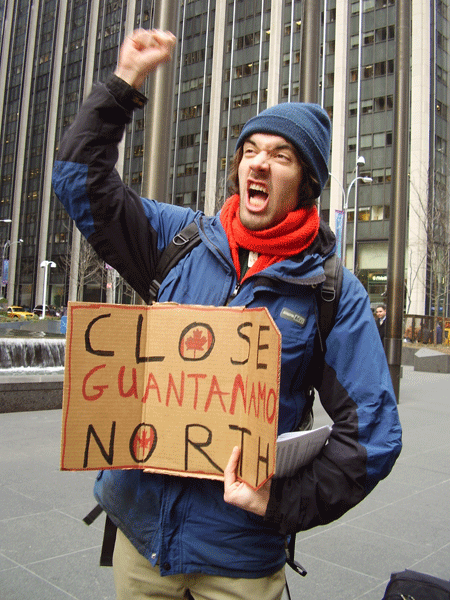
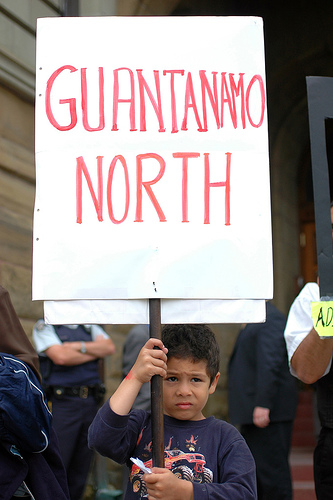
In April 2006, Mahjoub, along with three other security certificate detainees, was transferred to the newly opened "Kingston Immigration Holding Centre", which was soon dubbed "Guantanamo North". The six-cell facility was opened specifically to detain security certificate detainees; far from their families and support groups, the detainees felt that they were being abandonned.
Mahjoub, with two of the other detainees at Guatanamo North, went on hungerstrike in Winter of 2006. He ended the 93-day hunger strike just before a February 15th 2007 Federal Court ruling ordering Mahjoub to be released. The ruling noted in particular his failing health and the fact that he presented no risk to Canadian society.
Then, on February 23rd 2007, the Supreme Court of Canada ruled that the security certificate review process was unconstitutional. The Supreme Court unfortunately suspended their ruling striking down the entire section of the law, leaving the security certificate detainees in limbo for one year.
Some months after the ruling to release him, he was finally transferred from Guantanamo North to his home in Toronto. The conditions of his release were extremely severe, and in practice turned his home into a prison and his family into his prison guards. He was kept under a 24-hour surveillance by members of his family; he could never be left alone, neither in the home nor on the strictly limited occasions he was allowed to leave the home.
Excursions from the house were restricted to a few times of limited number of hours a week and each one had to be applied for 48-hours in advance. Excursions were often refused, consigning the entire family to house arrest (since his wife was forced to accompany him and their children were too young to go out by themselves). Many other conditions applied.
In February 2008, the old security certificate law finally fell. However, the government enacted a new law, almost identical to the old one (all major human rights organizations and legal organizations took the opinion that it remained unconstitutional).
Under the new law, a new security certificate was issued for Mahjoub and four other security certificate detainees. Thus after almost eight years of detention without charge, he faced undergoing the same process all over again, under a law that remains unconstitutional according to the Canadian Bar Association and many other organizations.
On 18 March 2009, Mahjoub returned to prison at Guantanamo North in Kingston. This was the only choice left for Mahjoub, as he explained on March 19th to Federal Court Justice Simon Noel. He could no longer subject his family to the intolerable anbject his family to the intolerable and humiliating invasions of their privacy that the conditions of his house arrest required.
Further background: Homes Not Bombs: Secret Trials

The People's Commission Network is a working group of QPIRG-Concordia qpirgconcordia.org 514.848.7585 info@qpirgconcordia.org

Contact the People's Commission Network: QPIRG Concordia - Peoples's Commission Network c/o Concordia University 1455 de Maisonneuve Ouest Montreal, QC, H3G 1M8 commissionpopulaire@gmail.com
This website is based on the Fluid 960 Grid System